











How to Wash Dreadlocks - A Gentle and Balanced Approach
One of the most common questions we get is:
How often should you wash dreadlocks?
If you’ve ever felt unsure or worried about washing your dreads “too much” or “too little”, you’re not alone. There is a lot of conflicting advice out there - and much of it is based on rules rather than understanding.
Let’s take it calmly and from the beginning.
There is no one-size-fits-all routine
Dreadlocks don’t all behave the same - and neither do scalps.
How often you should wash your dreads depends on:
- Your scalp type
- The age and type of your dreadlocks
- Your activity level and climate
- How your scalp reacts after washing
Healthy dread care is not about following strict rules - it’s about balance and awareness.

How often should you wash dreadlocks?
It depends on your scalp, your dreads - and your everyday life
We often get asked if dreadlocks should be washed once a week, twice a week - or less.
The honest answer is: it depends.
Not because it’s complicated - but because dreadlocks, scalps and lifestyles are different.
Below is a gentle guideline to help you understand what usually works best for different needs.
Who often benefits from washing around 2 times per week
You may feel better washing a bit more frequently if you:
- Have an oily scalp
- Sweat a lot (workouts, physical work, hot climate)
- Experience itching caused by sweat or oil build-up
- Have baby dreads where the scalp is still adjusting
- Live in a humid environment
If you work out daily, this does not necessarily mean you need to wash your hair every day. For many people, simply rinsing the hair with water between washes is enough to remove sweat and salt – and using shampoo only a couple of times per week.
Often, a wash routine of around two times per week works well for people who sweat a lot but still want to maintain the scalp’s natural balance.
In these cases, washing can help keep the scalp calm and balanced – as long as the shampoo is mild and residue-free, and your dreads are fully dried afterwards.
Washing more often does not mean washing harder – it simply means supporting your scalp when it needs it.
Who often benefits from washing less frequently
You may do better with fewer washes if you:
- Have a dry or sensitive scalp
- Experience tightness, flakes or irritation after washing
- Have mature dreads that hold moisture differently
- Live in a dry or cold climate
- Don’t sweat much in daily life
In these cases, washing too often can disturb the scalp’s natural balance and actually create more dryness and irritation.
Here, once a week - or even slightly less - is often enough.
The most important rule (more important than numbers)
Instead of counting days, pay attention to signs:
- Does your scalp feel calm?
- Do your dreads feel light and clean - not sticky or heavy?
- Is there no unpleasant smell?
If yes - your routine is working.
If not - adjust gently. Not by washing more or less automatically, but by listening to what your scalp is telling you.

Why over-washing can create problems
Washing too frequently - or with the wrong shampoo - can lead to:
- Dry or irritated scalp
- Increased itching (even if the scalp is actually dry)
- An unstable moisture balance
- Dreads that feel rough or dull
More washing is not always better. Often, gentler washing is.
How to wash dreadlocks correctly (step by step)
Keeping the process simple is key.
- Make sure your dreads are fully wet
- Apply a mild, residue-free shampoo to the scalp
- Massage gently with your fingertips - focus on the scalp, not the dreads
- Rinse very thoroughly
- Squeeze out excess water
- Dry your dreads completely
Drying is just as important as washing. Dreads that stay damp inside can lead to odor, irritation and imbalance over time. Gently squeeze out excess water with a towel (avoid rubbing), allow plenty of airflow, and make sure your dreads are fully dry all the way through before tying them up or covering them. Helpful tools like a bamboo microfiber towel or a drying cap can support faster and more even drying, especially for thick or long dreads.

Choosing the right shampoo
Not all shampoos are suitable for dreadlocks.
A good dreadlock shampoo should:
- Be mild and gentle
- Be residue-free
- Support the scalp’s natural balance
Choose shampoo based on your current need, not on habit.
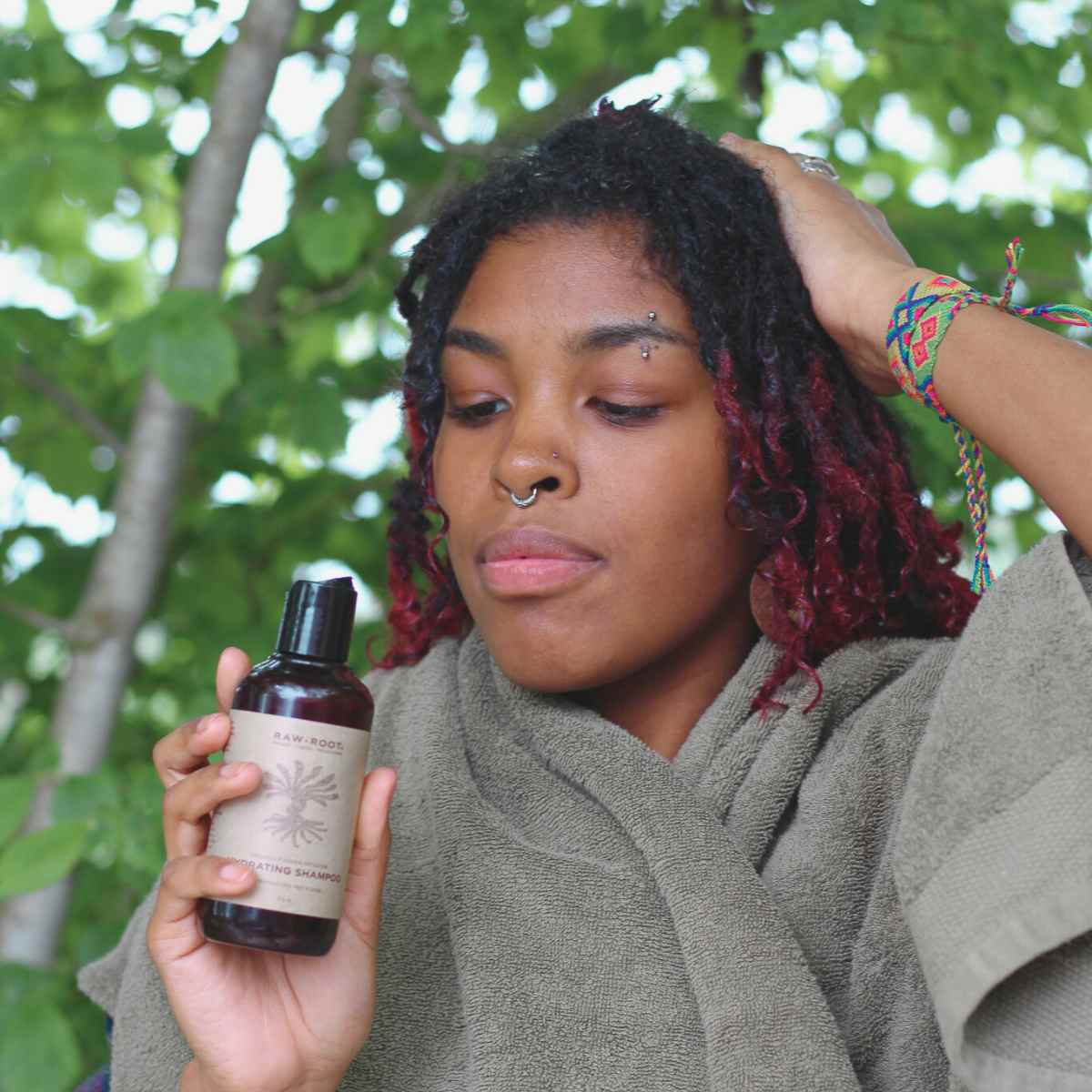
All RAW ROOTs shampoos are formulated to be residue-free and gentle on both scalp and dreadlocks, as build-up is one of the most common causes of imbalance over time.
Some people benefit from a hydrating shampoo for dry or sensitive scalps, while others occasionally need a clarifying wash to remove build-up.
If you’re unsure which type of shampoo suits your scalp and dreadlocks best, we’ve written a separate guide that walks you through the choice calmly and step by step.
You can find it here: Which shampoo is best for your dreadlocks?
What about smell between washes?
A healthy routine should not rely on covering up odor.
If you experience smell between washes, it is often a sign of:
- Dreads not drying fully
- Build-up over time
- A scalp that is out of balance
If build-up has developed gradually over time, a gentle detox wash can be helpful to reset both scalp and dreads. Detox treatments should not be used frequently, but only when there is a clear need - for example if dreads feel heavy, dull or start to smell even after washing.
If you want to learn more about when and how to detox dreadlocks properly, we’ve written a dedicated guide that explains the process calmly and step by step. You can find it here: our complete Dreadlock Detox Guide
A light, residue-free refreshing spray can be helpful between washes to support freshness and balance, but it should never replace proper washing and drying. For this purpose, our Refreshing Mist is designed as a gentle support between washes - not as a shortcut.
A calm reminder to end with
Healthy dreadlocks don’t come from overdoing or controlling every step.
They come from:
- Consistency
- Patience
- Respect for the scalp and hair
If your scalp feels calm and your dreads feel light and clean, you are on the right path.