






New Dreadlocks Guide - How to Get Off to a Great Start
Congratulations on your new dreadlocks!
If you have a lot of questions right now, you are far from alone.
Can I wash them?
Is it normal for them to stick out?
Why does my scalp itch?
Am I doing it right?
The first while with dreadlocks can feel overwhelming. The good news is that most of what you experience in the first few months is completely normal.
In this guide, we'll go through the most important things you need to know, what to expect, and how to give your dreadlocks the best possible start. Along the way, we'll link to our more in-depth guides if you want to read more about a specific topic.
The 5 Most Important Things to Know
- Wash when your scalp needs it.
- Always ensure your dreadlocks are completely dry.
- Palm rolling is the most important habit in the initial period.
- Frizz and loose hairs are a natural part of the maturing process.
- Use residue-free products.
It's Completely Normal to...
If you've never had dreadlocks before, the initial period might come as a surprise.
Many become concerned because their dreadlocks look different after just a few days or weeks than they did when they left the salon. They become softer, fluffier, and less "perfect," and suddenly a lot of questions arise. Fortunately, this does not mean that anything is wrong. On the contrary, it is usually a sign that your dreadlocks are in the process of maturing.
During the first few months, it is completely normal to experience:
- an itchy or slightly irritated scalp
- frizz and loose hairs sticking out
- dreadlocks that flatten after a night on the pillow
- dreadlocks that feel softer after washing
- dreadlocks that shrink and lose a bit of length
- dreadlocks that look less "finished" than the day they were created
If you recognize several of these things, you are probably exactly where your dreadlocks should be.
In the rest of the guide, we'll go through why this happens, what you can do, and which habits make the initial period much easier.
What Maturing Actually Looks Like
One of our customers started her dreadlock journey by only having the bottom rows of hair done. Over the next year, she gradually had the rest done. This means that today she has dreadlocks of several different ages on the same head. This provides a unique opportunity to see how new dreadlocks develop.
In the pictures below, you can clearly see the difference between the immature and the mature dreadlocks.
The mature dreadlocks are more compact, smooth, and uniform. The new ones have more loose hairs, more volume, and small bumps along the way. This is not a sign that something has gone wrong. This is what the maturing process looks like.

If you're curious about what to expect throughout the first year, we've created a complete guide to the four stages of dreadlock development.
→ Read the guide: The 4 Stages of Dreadlocks
Your First Hair Wash
"When can I wash my new dreadlocks?"
That's probably the question we get most often.
You may have heard that you should wait several weeks. Others say you should wash them immediately. The truth is, there isn't a specific number of days that works for everyone.
The best rule of thumb is:
Wait as long as you can - but wash them when your scalp starts to itch.
Itching is often the body's way of saying it's time for a hair wash.
Once you've gotten into your routine, most people will benefit from washing their dreadlocks about once a week. Some wash a little more often, others a little less often - it depends, among other things, on your scalp, your job, and how active you are.
If you exercise a lot or sweat a lot in everyday life, it's perfectly fine to rinse your hair with water between washes if it feels good.
If you want to know more about hair washing, we've written a complete guide that goes into much more depth.
→ Read our guide: How to Wash Your Dreadlocks
Always Choose a Residue-Free Shampoo
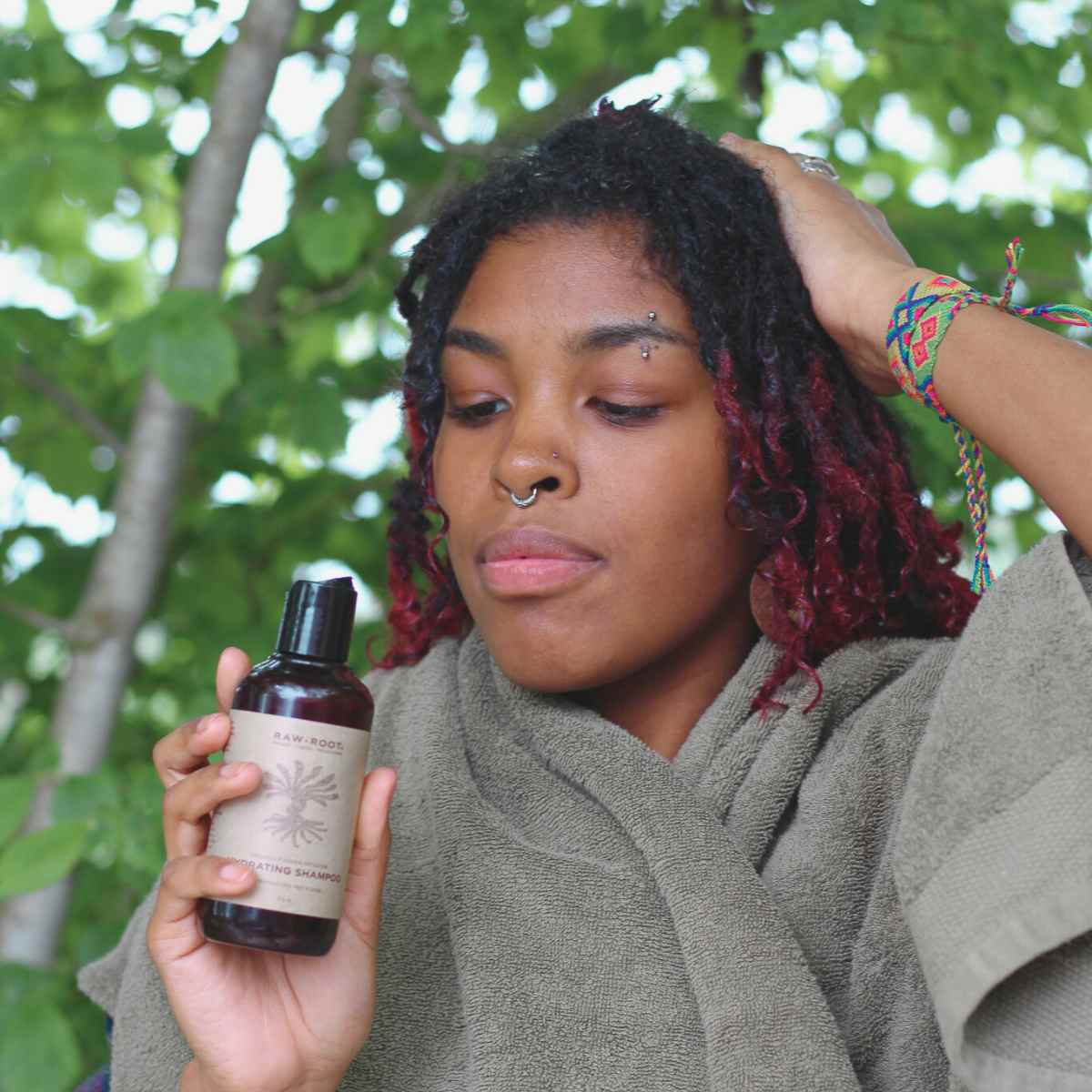
When choosing a shampoo for your dreadlocks, the most important thing is that it is residue-free.
A residue-free shampoo rinses completely out of the hair and does not leave residues that can accumulate inside the dreadlocks over time. Therefore, all RAW ROOTs shampoos are developed without ingredients that leave coatings.
If you're curious about what "residue-free" actually means and why it's so important for dreadlocks, you can read our guide here.
→ What does residue-free shampoo mean?
If you're unsure which shampoo is best for you, we've created a guide to help you choose.
→ Read the guide: Which dreadlock shampoo should I choose?
Why We Recommend Greenie Genie for New Dreadlocks
If we could only choose one shampoo for brand new dreadlocks, it would be Greenie Genie Soap Bar.
Not because the other shampoos aren't good - but because Greenie Genie is developed with ingredients that are particularly suitable for the initial period.
When you get dreadlocks, the scalp often becomes a little stressed. This is to be expected and can manifest as itching or irritation.
Greenie Genie is an herbal soap bar developed to help a stressed scalp return to balance. It also contains Himalayan salt, which adds extra texture to new dreadlocks.
That's why it's a permanent part of our Exclusive Dreadlock Starter Kit.
If you have other needs - for example, a very dry scalp - you can easily supplement with one of our other shampoos.
We recommend washing your hair twice. The first wash cleanses the hair and scalp, while the second wash is a good opportunity to choose the shampoo that best suits your scalp's current needs.
Your scalp can change over time. What works best right after you get dreadlocks is not necessarily the same six months or a year later. Therefore, you can easily switch between different residue-free shampoos or combine them in the same wash.
Always Make Sure Your Dreadlocks Are Completely Dry
The hair wash itself is only half the task.
It's just as important that your dreadlocks are allowed to dry completely afterwards.
Dreadlocks can hold more water than you might think, and if they often remain damp inside, it can eventually lead to bad odor and create an imbalance in both hair and scalp.
Gently squeeze out excess water with a towel - avoid rubbing - and ensure good air circulation while they dry. Wait to put your hair up or wear a hat until your dreadlocks are completely dry.
If you have long or very thick dreadlocks, a bamboo microfiber towel or a Dreadlock Drying Cap can make drying time both faster and more comfortable.
In short
✓ Wash when your scalp starts to itch.
✓ Always use a residue-free shampoo.
✓ Greenie Genie is a good choice for new dreadlocks.
✓ Feel free to wash your hair twice.
✓ Always let your dreadlocks dry completely.
Your First Care Routine - Keep it Simple
Once you've got hair washing down, the rest is actually pretty simple.
You don't need a long routine or a shelf full of products. Most new dreadlocks need the same few things again and again: a clean scalp, a little help to maintain their shape, and the right type of moisture.
The most important thing is that you do a little - but do it regularly.
Palm Rolling - The Most Important Habit in the Initial Period
If there's one thing we'd recommend to everyone with new dreadlocks, it's to make palm rolling a daily habit.
Palm rolling helps your dreadlocks maintain their shape, reduces flattened sides after sleep, and supports the hair in naturally tightening as it matures.
It doesn't have to take long. A few minutes a day is enough for most.
Palm rolling step by step. Apply a small amount of Tightening Gel to the dreadlock and gently roll it between your palms, moving your hands up and down the dreadlock. A few calm movements are enough - you don't need to use force.
Many also choose to palm roll their dreadlocks after washing, while they are still towel-dried or slightly damp. At that point, the hair is more pliable, and it's an ideal time to help the dreadlocks regain their shape.
If you don't already know how to palm roll, we've created a guide showing the technique step by step.
→ Read our guide to dreadlock maintenance.
Moisturize New Dreadlocks - But Wait with Oil
It surprises many, but brand new dreadlocks don't need oil in the lengths.
Normally, oil is an important part of a dreadlock routine, but for the first few months, the hair is still in the process of tangling and maturing. Oil can make the hair too slick and make it harder for dreadlocks to develop naturally. Therefore, we recommend water-based moisture instead.
Tightening Gel is the primary moisture source we recommend for new dreadlocks. It's perfect for palm rolling and provides the water-based moisture the hair needs in the initial period.
That's why Tightening Gel is included in our Exclusive Dreadlock Starter Kit.
After about six months - or when your dreadlocks start to feel more mature - you can gradually begin to introduce oil into the lengths if they feel dry.
If you're unsure when your dreadlocks are ready, you can start by mixing a single drop of Hydrating Oil with Tightening Gel. This provides a little extra nourishment without making the hair too slick.
Rescue Tonic - When Your Scalp Needs a Little Extra Care
Even though itching and irritation are completely normal, it doesn't mean you just have to accept it.
If your scalp feels dry, warm, or irritated, Rescue Tonic can be a great help - which is why it's also part of our Exclusive Dreadlock Starter Kit.
Spray it directly onto your scalp when you need it - both after and between washes.
It has a cooling and soothing effect, and many find that it quickly calms itching.
A small tip: Store the bottle in the refrigerator in the summer. It feels extra cooling on a warm or sun-affected scalp.

Want it all in one place?
If you prefer not to find the most suitable products for the initial period yourself, we've put them together in our Exclusive Dreadlock Starter Kit.
The kit gathers the products we most often recommend for the initial period:
- Greenie Genie Shampoo Bar
- Tightening Gel
- Rescue Tonic
- Satin Lined Sleep Tube
- Crochet hooks
These are the products we most often recommend to new dreadlock owners because they address the needs most people experience in the initial period. As your dreadlocks mature, you can always build on the routine with products that suit your specific needs.
In short
✓ Palm roll a little every day.
✓ Use Tightening Gel as your primary moisture source.
✓ Wait with oil in the lengths for the first few months.
✓ Use Rescue Tonic when your scalp needs it.
✓ Add more products as your needs change - not because you feel you should.
Learn to Maintain Your Dreadlocks - Little by Little
When you've had your dreadlocks for a short time, you'll probably notice more and more loose hairs. This is a natural part of the maturing process.
Some choose to leave them, while others like to re-tuck them along the way. There isn't one right way to do it - it's about the look you want.
The So-Called "Butterflies"
Do you see loose tufts or "bumps" on your new dreadlocks? We lovingly call them butterflies, and they are simply loose hairs that have not yet found their place in the dreadlock.

Palm rolling helps many of them over time. If you want a more uniform look, they can be gently worked in with a crochet hook.
How to Learn to Use a Crochet Hook
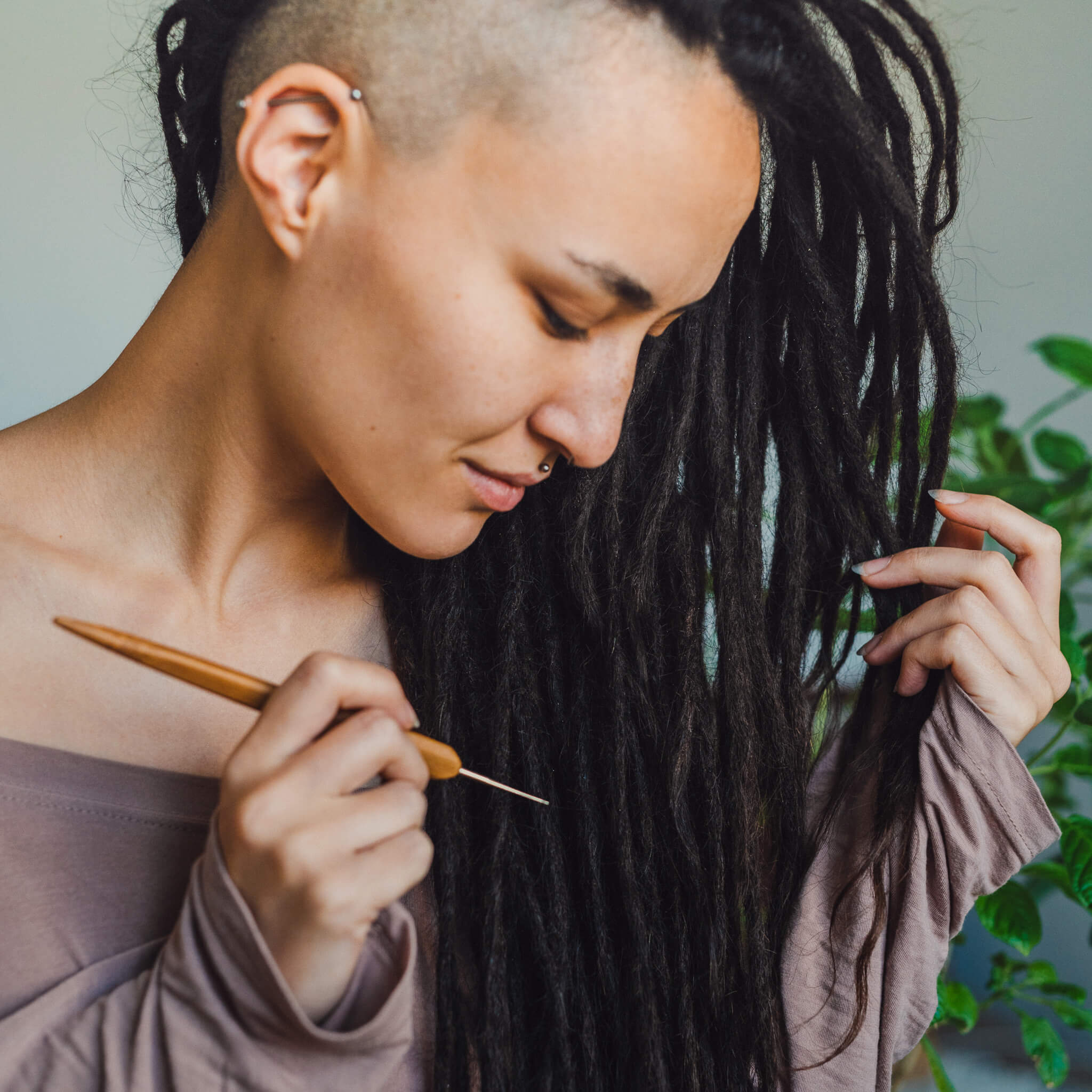
Many get nervous the first time they use a crochet hook. You don't have to be. You can start practicing right from the beginning - as long as you work calmly and gently.
For some, it provides great peace of mind to be able to gather the loose hairs that naturally appear after the first few washes. This doesn't mean you have to maintain all your dreadlocks all the time - only that you can help individual loose hairs along when you want to.
A crochet hook should not be used to pull hair through the entire dreadlock.
It should be used to gently guide loose hairs back to where they naturally belong.
In short, the technique involves:
- catching the loose hairs with the crochet hook
- gently guiding them into the dreadlock
- slightly twisting the hook so the hairs release
- pulling the hook out without tearing the hair
If hair gets stuck on the hook when you pull it out, it's often a sign that the technique needs to be adjusted.
The goal is to preserve the hair - not tear it out.
→ Watch our guide to maintenance with a crochet hook on YouTube.
 The Most Important Thing is Not to Overdo It
One of the most common mistakes is believing that new dreadlocks should be completely tight.
They shouldn't be. New dreadlocks are naturally softer than mature dreadlocks, and they need space to develop.
If you crochet them too much, they can become unnecessarily hard and lose some of the natural movement they need during the maturing process. Therefore, don't try to make them look "finished." They will become tighter and firmer over time.
When Is It Time for Repair?
After a couple of months, your hair will start to grow out at the scalp.
Most people choose to have a major maintenance (repair) done approximately every 3-4 months, depending on how fast their hair grows and what look they desire.
Here, the new growth at the scalp is maintained, and your loctician will typically also gather loose hairs and "butterflies" so your dreadlocks regain a more uniform appearance.
Most people have repairs done by their loctician, as it can be difficult to maintain your own roots - especially in places you can't see yourself.
If you don't want to learn how to use a crochet hook yourself, that's perfectly fine. You can simply palm roll in your daily routine and let your loctician handle the maintenance when it's time for a repair.
Questions Many Have During the Initial Period
The first while with dreadlocks brings many questions. Here we've gathered some of the ones we get most often.
What's the Difference Between Tightening Gel and Tightening Spray?
Both Tightening Gel and Tightening Spray help to gather loose hairs and maintain your dreadlocks - the difference lies in what they add to the hair.
Tightening Gel works with moisture, care, and a natural, flexible hold. It is therefore an obvious choice for palm rolling and is the primary moisture source we recommend for brand new dreadlocks.
Tightening Spray, on the other hand, provides more texture and a firmer hold. It is especially good if you want to tame flyaways or create extra grip when working with a crochet hook.
Many actually use both products in their routine - not because one replaces the other, but because they have their own strengths.
What if I want to keep my dreadlocks fresh between washes?
It might not be time for a hair wash yet, but your dreadlocks need to feel fresh again.
Here, Refreshing Mist is one of those products that surprises many.
Although the name might sound like a fragrance spray, it's much more than that.
Refreshing Mist immediately eliminates odor and bacteria while providing nourishing ingredients.
It's especially lovely after a workout, a long day at work, a trip to a restaurant, or if your dreadlocks just need a quick refresh.
It's not a substitute for washing your hair - but it can postpone your next hair wash and make the wait much more pleasant.
What if my hair has trouble locking?
Some hair types tangle faster than others.
If your hair has trouble holding its shape, Dry Shampoo (Lock Powder) can help.
It provides extra texture and "grip," which can make it easier for the hair to lock and also add a bit more volume at the roots.
However, it's not something most people need from day one - but it can be a good supplement if you find your hair very smooth or difficult to work with.
What if I'm worried about lice?
If you have children in daycare or school, or if you work somewhere where lice are often circulating, Creeps Tincture can provide extra peace of mind.
It can be used both preventatively and as part of treatment if an infestation occurs.
For most people, it will never be necessary - but many are happy to have it on hand if the need arises.
May I use conditioner?
Yes - but not in the dreadlocks themselves.
Conditioner makes hair smoother and counteracts the natural maturing process.
If you have loose hair alongside your dreadlocks, for example, bangs or partial dreadlocks, you can certainly use conditioner on the loose hair. Just be sure to separate the loose hair and dreadlocks when applying conditioner.
May I dye my dreadlocks?
Yes.
Dyeing dreadlocks is essentially no different from dyeing loose hair.
However, if you use a home dye, be aware that some dyes contain conditioner or nourishing ingredients that can make the hair smoother. Always wash your hair thoroughly afterward with a residue-free shampoo.
May I go to the swimming pool or swim in the sea?
Yes.
Salt water and chlorine do not damage your dreadlocks, but they can dry out both hair and scalp.
Rinse your hair with clean water afterward, and wash it with shampoo if it has been exposed to a lot of chlorine.
If you swim often, a Dreadlock Silicone Swimming Cap can be a great help to keep dreadlocks dry.
→ Also read our guide to summer care for dreadlocks.
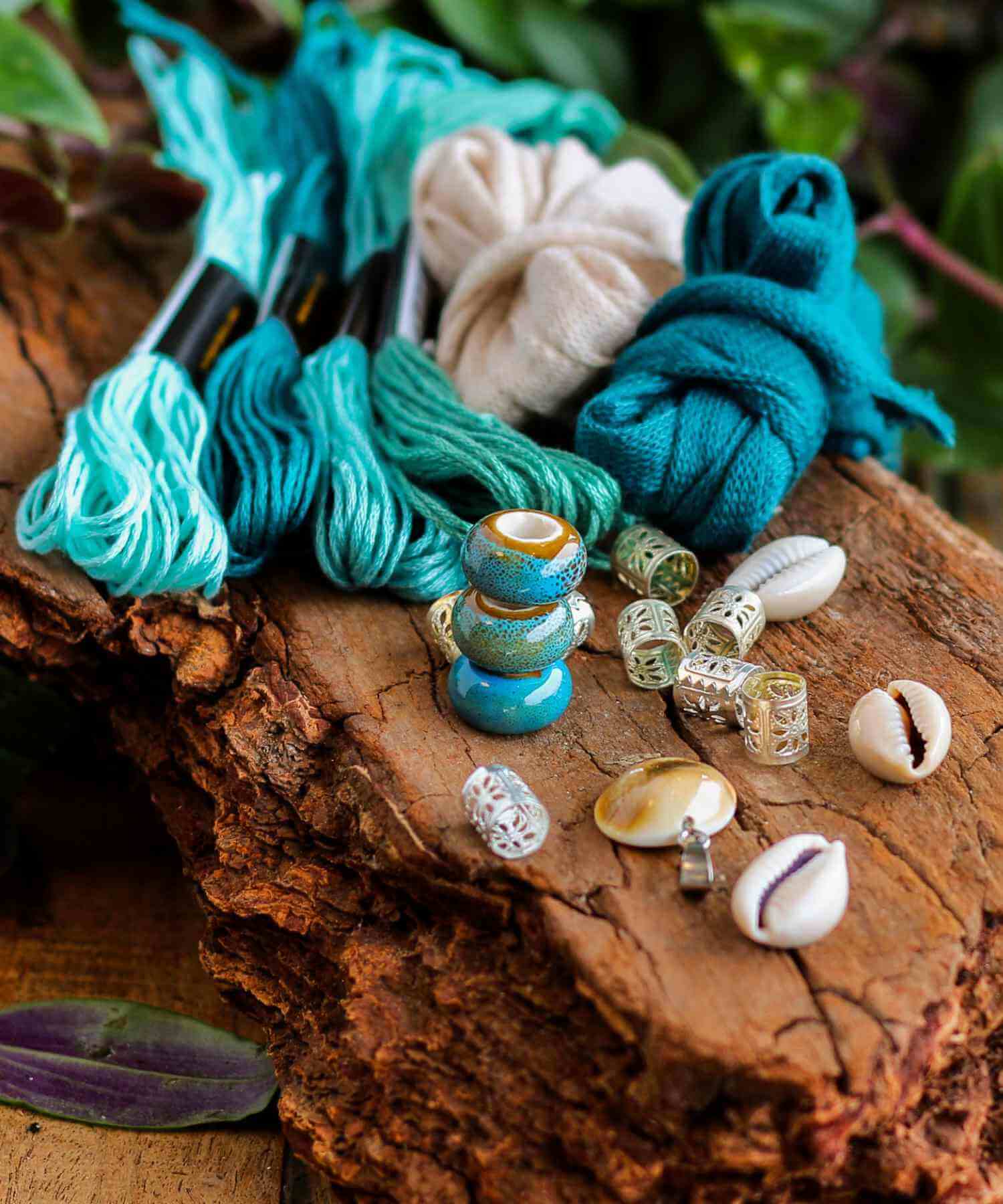
May I use decorations?
Yes.
You are welcome to use dreadlock decorations right from the start.
However, because your dreadlocks are still forming, we recommend that you move the decorations regularly and remove them before washing your hair.
As your dreadlocks mature, decorations can often stay in place for much longer.
May I detox my dreadlocks?
Not yet.
We only recommend detoxing dreadlocks when they are about a year old.
Until then, regular hair washing with a residue-free shampoo is more than enough.
If you need a shampoo that cleans a little extra thoroughly, Midnight Magic Shampoo Bar can be a good choice. It cleans effectively without being harsh on the hair.
→ Read our complete guide to dreadlock detox.
When does the routine change?
The first period is mostly about helping your dreadlocks to mature.
As they get older, their needs gradually change.
The first 6 months
- Focus on a healthy scalp.
- Water-based moisture with Tightening Gel.
- Palm rolling.
After approximately 6 months
- You can start using oil on the lengths if they feel dry.
- Most people experience fewer loose hairs.
- Your dreadlocks will start to hold their shape better.
After approximately 1 year
- Most dreadlocks are now mature enough for you to start detoxing them as needed.
- The care routine often becomes more flexible, and many find they spend less time on maintenance than at the beginning.
→ Read our complete guide to the ongoing care routine for mature dreadlocks.
When should you contact your loctician?
While most challenges can be handled at home, there are situations where it's a good idea to seek help.
Contact your loctician if:
- you experience persistent pain.
- your scalp becomes very irritated or inflamed.
- you are unsure how to maintain your dreadlocks.
- you would like help with a major tightening.
- you just need an experienced pair of eyes on your dreadlocks.
It's always better to ask once too often than once too little.
Your dreadlock journey has just begun
If you only remember one thing from this guide, let it be this:
You don't have to do everything perfectly.
Wash when your scalp needs it.
Palm roll a little every day.
Keep them completely dry.
Give them water-based moisture initially.
Frizz, loose hairs, and changes usually don't mean something is wrong. They mean your dreadlocks are maturing.
Feel free to save the guide and refer back to it when new questions arise.